
Engagement at Stanford:
A Passion for Learning, Leads to Contributions
in the Classroom
Universities experience a challenge finding and recruiting individuals who have experience applying new, cutting edge technologies in “real world” settings, and who can bring their practitioner’s expertise and perspective to the classroom. A recent example is Artificial Intelligence (AI).
Bringing Unique Experience to the Classroom
In 2016, self-described “inventor, investor and teacher” Ronjon Nag came to Stanford to participate in a new program – the Stanford Distinguished Careers Institute (DCI). Always one to participate in the early stage of a new venture, Ronjon joined DCI’s second cohort.
A pioneer in deploying Artificial Intelligence (AI) systems, Ronjon came from Cambridge and MIT to the Stanford Psychology department in 1991, to work on “neural networks,” the foundation of modern AI systems. Ronjon has been involved in the AI field for more than 40 years – founding and advising AI companies sold to Motorola, BlackBerry and Apple and continues to work on cutting edge AI concepts. Earlier this year, Ronjon was inducted into the 2024 Silicon Valley Engineering Hall of Fame.

Ronjon Nag (DCI 2016)
While a DCI Fellow, an instructor invited Ronjon to share his industry experience as a guest lecturer at her new AI class. As the year progressed, so did Ronjon’s appearances as a guest lecturer. Ronjon recalls, “by the time the fourth quarter came, the instructor suggested, “Why don’t you just teach the entire course? And so that’s how I got started teaching artificial intelligence at Stanford.”
Ronjon came to the attention of Stanford’s Continuing Studies program, which offers a broad range of courses to more than 17,000 lifelong learners each year, and was seeking someone who could teach AI. “When we first offered the course (in 2018) we didn’t fully grasp what AI was going to become, and how important this course would be,” recalls Dan Colman, Dean of Stanford Continuing Studies & Summer Programs. “We’re really fortunate to work with Ronjon. He has a deep understanding of AI and enjoys working with our students. It’s a combination that adds a lot to our program.”
To date, Ronjon has taught courses on longevity science, investing, and AI to over 3,000 Stanford University students and enrolled Stanford Continuing Studies students. In a recent review, a student shared “I truly loved every moment of this class. Ronjon is a treasure and brings knowledge and passion that drives high engagement, even across Zoom.”
Collaborating with Faculty at The School of Medicine
During his DCI year, Ronjon walked his curiosity across Campus Drive to the School of Medicine, where he took a class with William Hurlbut, MD, Adjunct Professor and Senior Research Scholar in Neurobiology. Professor Hurlbut invited Ronjon to work on his major project, The Boundaries of Humanity: Humans, Animals, and Machines in the Age of Biotechnology. “Ronjon’s breadth of background, deep insights, and enormous intellectual energy have added immeasurably to the interdisciplinary dialogue that is at the core of our efforts,” notes Professor Hurlbut.
Teaching and Mentoring Students
His passion for longevity science led Ronjon to the Genetics department where he met and quickly bonded with Mike Snyder, PhD, Chair, Department of Genetics and Director, Center for Genomics and Personalized Medicine. Together they collaborate on projects related to predicting diseases and longevity science, as well as co-teach classes. Ronjon became an Adjunct Professor in Genetics at Stanford Medicine in 2022.
Snyder explains that Ronjon fills an important role that didn’t previously exist in the School of Medicine. The Graduate School of Business (GSB) offers some venture-related courses, but none include the biological and AI science aspects in combination with business that Ronjon brings to courses at the School of Medicine.

An early innovator in AI, Ronjon was featured on the cover of Fortune magazine in 1993. Most recently Ronjon was inducted into the Silicon Valley’s Engineering Hall of Fame.
Over the past three years Ronjon has co-taught several classes with Professor Snyder: GENE 223 – Aging: Science and Technology for Longevity; GENE 225 – Healthcare Venture Capital; GENE 226 – Longevity Venture Capital; GENE 231: AI for Beginners; and GENE 213 – AI Genes and Ethics.
“His teaching is amazing and the courses are extremely popular,” comments Snyder. “Ronjon is doing the heavy lifting; he’s definitely the anchor for these classes.” Ronjon adds, “our classes include students from all over the university. This is where the impact on Stanford is. We don’t exclude; we take students from any department and any age. We have everyone from first-year college students to faculty members in the classes.”
Brandon Nydick (Political Science, 2024) recalls his experience learning under Ronjon in all three courses. “Ronjon not only has a unique ability to break down complex topics, such as the biology of aging, inner workings of neural networks, and fundamentals of venture capital, into easily digestible ideas but also emphasized the importance of clear, simple communication in the sciences to his students, passing down this great skill.”
Sierra Lore, a recent Stanford grad and current PhD student at The Buck Institute, recalls her time in Ronjon’s classes. A lasting memory for Sierra is “how incredibly approachable and available Ronjon makes himself to students. That is unique especially for someone at his level of accomplishment. Students are a priority for Ronjon. He makes every effort to connect directly with students. I often wondered, how does he have enough time to do all of this – and run marathons?” (Ronjon has qualified twice for the Boston Marathon, including 2024).
DCI Fellows embrace the opportunity to both learn and also serve as mentors and teachers during their fellowship year on campus. Learning from faculty and students, while sharing their experience, knowledge, and industry connections. Ronjon Nag is an exemplar of how Fellows can make a difference in many ways and stay connected with the Stanford community.
“A true scholar, Ronjon is very embedded in the whole Stanford ecosystem at many different levels,” notes Mike Snyder. Ronjon’s contributions impact Stanford undergrads, graduate students, faculty, DCI Fellows and the community at large.
Learn more
Pose questions to Ronjon via his avatar!
View student papers from Ronjon’s courses.
By Kristin Goldthorpe, Stanford DCI, Communications Manager
"Mary Ellen exemplifies the mission of the DCI Fellowship. Through her intellectual leadership, strategic insight, and deep commitment to inclusion, she has made significant contributions to the Stanford Center for Neurodiversity and Human Potential.
As a trusted advisor to the Center, she has helped shape ideas and initiatives that advance understanding, opportunity, and belonging for neurodivergent individuals. Her work contributes to a growing global dialogue on how diverse minds strengthen organizations, enrich communities, and unlock human potential. Her efforts embody the transformative influence that one dedicated leader can have in creating a more inclusive and innovative world."
Dr. Lawrence Fung
Director, Stanford Medicine Center for Neurodiversity and Human Potential, Associate Professor of Psychiatry and Behavioral Sciences (Major Laboratories & Clinical Translational Neurosciences Incubator)
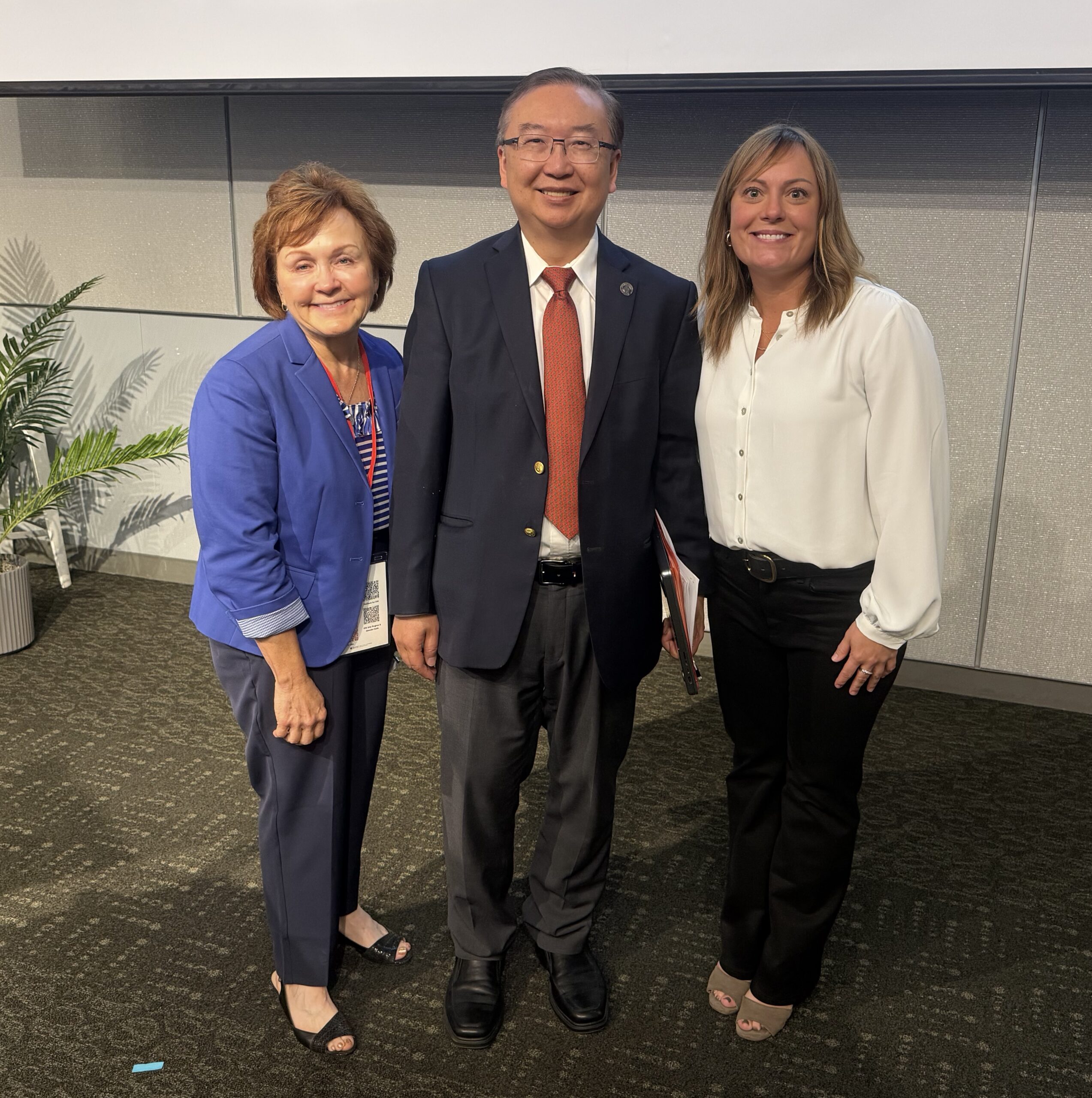
Mary Ellen with Dr. Lawrence Fung and Tarena Shanaberger (Microsoft) at Stanford's Neurodiversity Summit 2026.
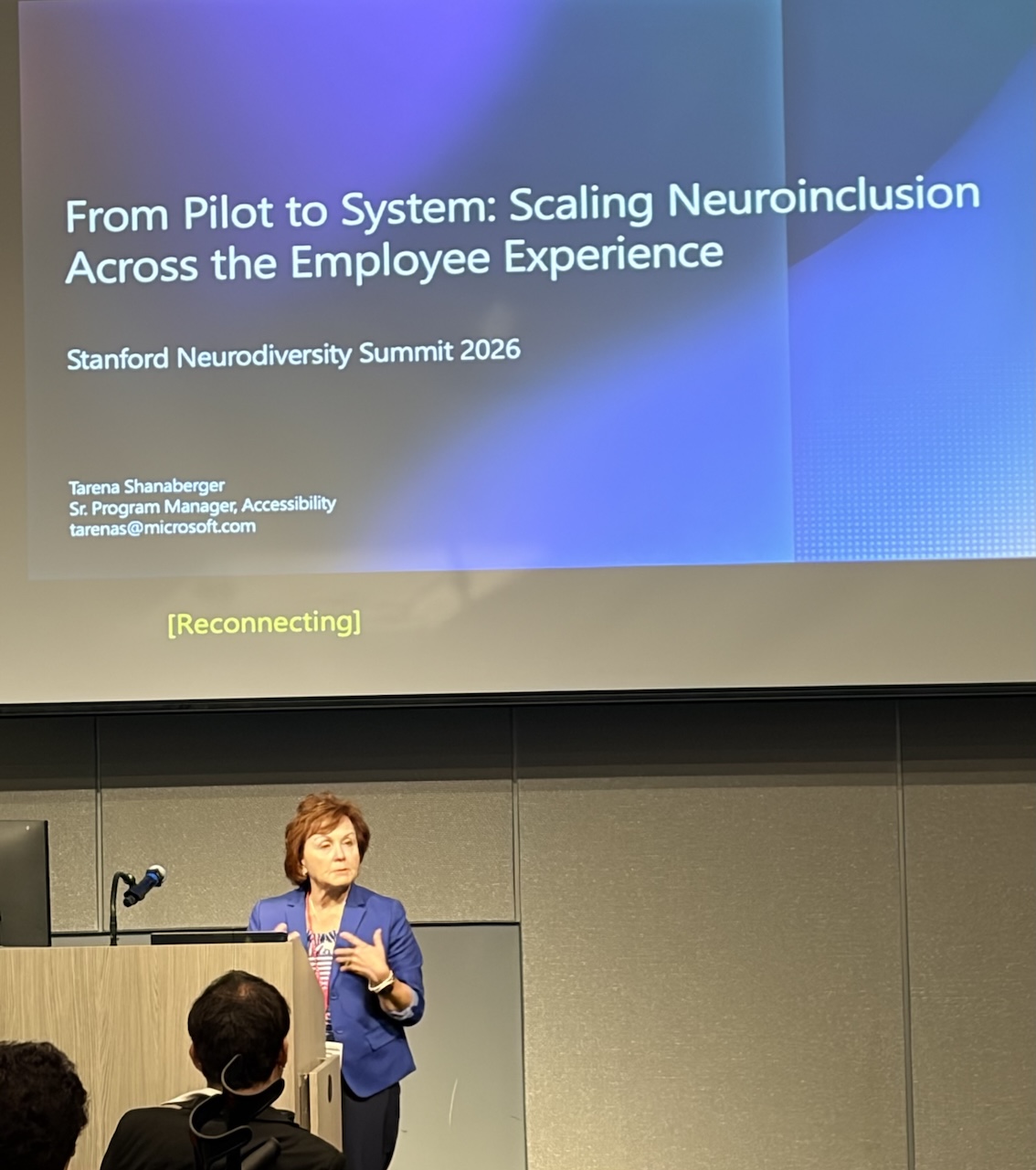
Mary Ellen addressing attendees at Stanford's Neurodiversity Summit 2026.
At the same time, I found deep fulfillment mentoring students across the university. Guest lecturing in Design Thinking classes for both graduate and undergraduate students allowed me to blend storytelling, leadership experience, and coaching, helping students explore how to design meaningful lives aligned with their values and aspirations. Their curiosity, resilience, and willingness to rethink their own paths inspired me daily and reminded me how energizing it is to support people at pivotal moments in their lives.
The impact of DCI didn’t end when the program did. It sparked two defining new paths. The first was my continued partnership and Advisory role with Dr. Fung and the Center for Neurodiversity and Human Potential, where I remain engaged in helping expand the reach and impact of neurodiversity research. The second was the creation of a transitions‑focused program rooted in identity, mattering, and design thinking — themes often overlooked during major life changes. After returning to Ohio, I developed and began piloting this program across the NE Ohio region helping people navigate change with greater clarity and confidence. I am now exploring university partnerships to scale its reach.
Alongside these new endeavors, I continue serving on public and nonprofit boards, applying decades of leadership experience to organizations committed to expanding opportunity and inclusion. Across all of this work, research, coaching, board service, the through‑line is clear: helping people and institutions recognize potential that might otherwise be overlooked.
DCI didn’t just open a new chapter. It reshaped the trajectory of my engagement - connecting lived experience, scholarship, and purpose in ways I never anticipated — and in ways that continue to allow me to grow.